

Have You Seen This Dog?
If the answer is “yes” then you probably already know what I am going to say. Save yourself some time reading this article – there’s no point preaching to the choir.
However, if you are not familiar with Doggo (for that is the name of this pup) – today is your lucky day. I am going to show you something that may just get you to enjoy searching the web again.
A bit of context
If you’ve been following tech news recently, you’ve probably heard about Google’s plan to turn their iconic search engine into an agentic AI summarizer. After purposefully handicapping their search engine to produce worse results (but in turn keep people on the site, consuming ads for longer) in the early 2020s, Google will now push actual links and results even further away from the user. Instead of directions to the relevant pages, we will now be served (often inaccurate) AI summaries.

It’s hard to overstate just how awesome and revolutionary Google’s search has been when it first launched. Until then, search engines were quite primitive, and could be gamed easily through brute force methods. To gain top ranks, one simply had to add a few paragraphs of “invisible” white-on-white text repeating the desired keywords. First generation search engines like Yahoo, Lycos, or AltaVista would eat it up.
Google’s PageRank system changed the landscape to the point where “to google” became synonymous with “to search the web”. It started strong, defining what a good search experience could be. For years it continuously evolved the algorithm, serving great results and battling the parasitic SEO industry.
Over time, though, Google dropped all pretenses of trying to make a good product—just as it dropped the don’t be evil motto. It injected more ads, made results worse on purpose, and is now replacing search with a chatbot.
Yet to many it comes as a surprise. We somehow got used to the idea of getting our searches for free from an advertising company and expected unbiased results.
There is no free stuff
Headlines are filled with recommendations for people looking for alternatives to Google search. There are plenty – Duck Duck Go, Brave, Ecosia, Startpage, just to name a few. Privacy focused, without ads, and free. I have tried all of them over the past few years. They all showed promise, but in the end fell short of my expectations.
Also, while I love not paying for stuff as much as anyone, every single free service has to have hidden costs. Perhaps it is time to try something absolutely revolutionary – to pay for stuff in order to get stuff.
Kagi.com
I first came across Kagi.com in an interview with Cory Doctorow. (His recommendation should already be enough for many.) I decided to give it a try. Kagi is a paid service, but does offer a substantial trial for free.
- On day one I created my free account and started searching. It was amazing. Writing it sounds ridiculous, but it was so refreshing to type a search query and get results that answered that query. The thing I would look for would always be one of the first three results served!
- On day two I hooked my wife. Got her a trial account and we searched the web like it was the 90s again
- On day three I subscribed us to a Kagi family plan and changed the default search on all devices
- On day four I started evangelizing to all my friends
- On day five I decided to do this write-up and share it with all of you*.
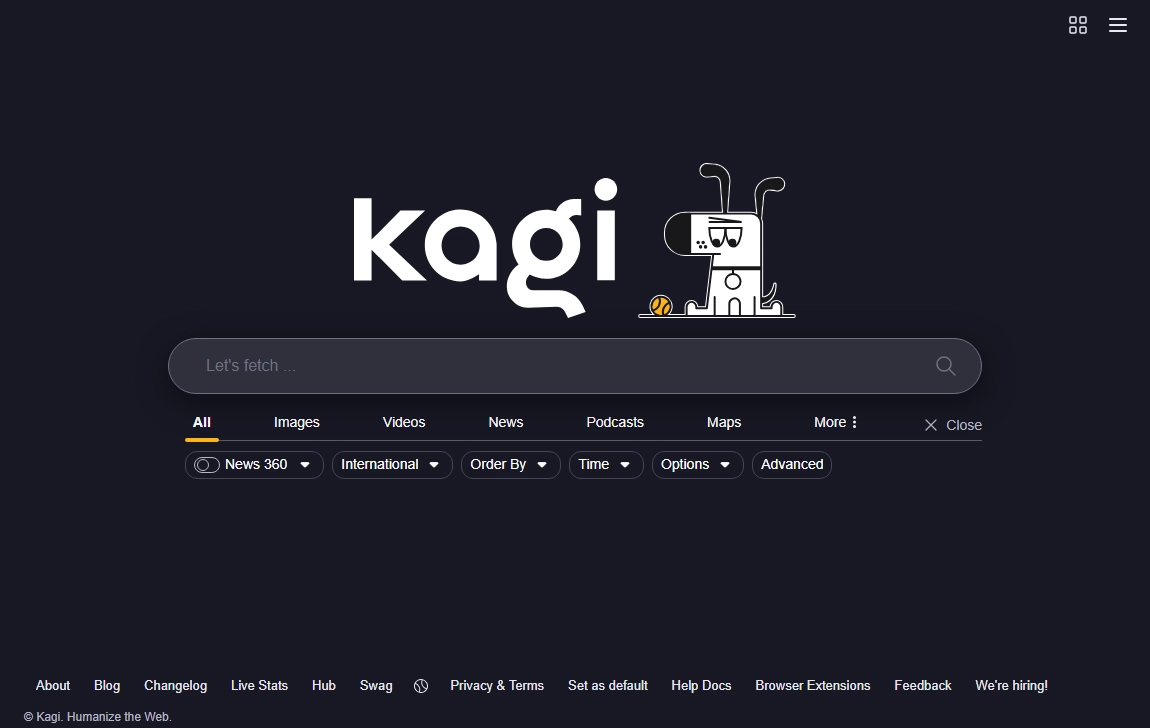
What’s so great about it
Personally, I think getting the results that accurately answer the search query should be enough of a motivation. But wait, there is more.
- For all the AI enthusiasts, there is an AI summarizer that you can freely enable or disable. It is enough to add a question mark to the end of your search to switch from search to assistant mode. Pretty nifty.
- For all the AI skeptics the SlopStop feature is a community-driven effort to report AI-generated pages and exclude them from future search results.
- Users can weigh/grade results to personalize the types of sources Kagi prioritizes (e.g. more Wikipedia, less Pinterest)
- Bangs can filter and customize the results:
!nl bikewill search for bikes in Dutch sites only. - Lenses, Filters, and Snaps are even more tools that allow users to precisely dial in the scope of their search
There’s also Kagi News, Kagi Maps, Translate, Summarize and other services – all neatly tucked around the site’s UI to be both accessible and unintrusive.
Love, hate, love
I used to love searching the internet. Then the marching enshittification of the web made me hate it. Now, since I started using Kagi.com, I can honestly say I love searching again.
Search used to feel like a superpower: type a few words, follow a few links, learn something real. Somewhere along the way, that simple pleasure got buried under ads, SEO sludge, AI summaries, and corporate incentives that no longer seem aligned with helping people find things. Kagi is not magic, and it does not need to be.
Its appeal is much simpler than that: it makes search feel useful again. And after years of watching the web get harder to navigate, paying for a tool that respects the query, the result, and the person doing the searching feels less like a luxury and more like common sense.
* My move from US to Europe put a halt to that plan for several months, but thankfully Google’s AI plans made the article relevant again.